About
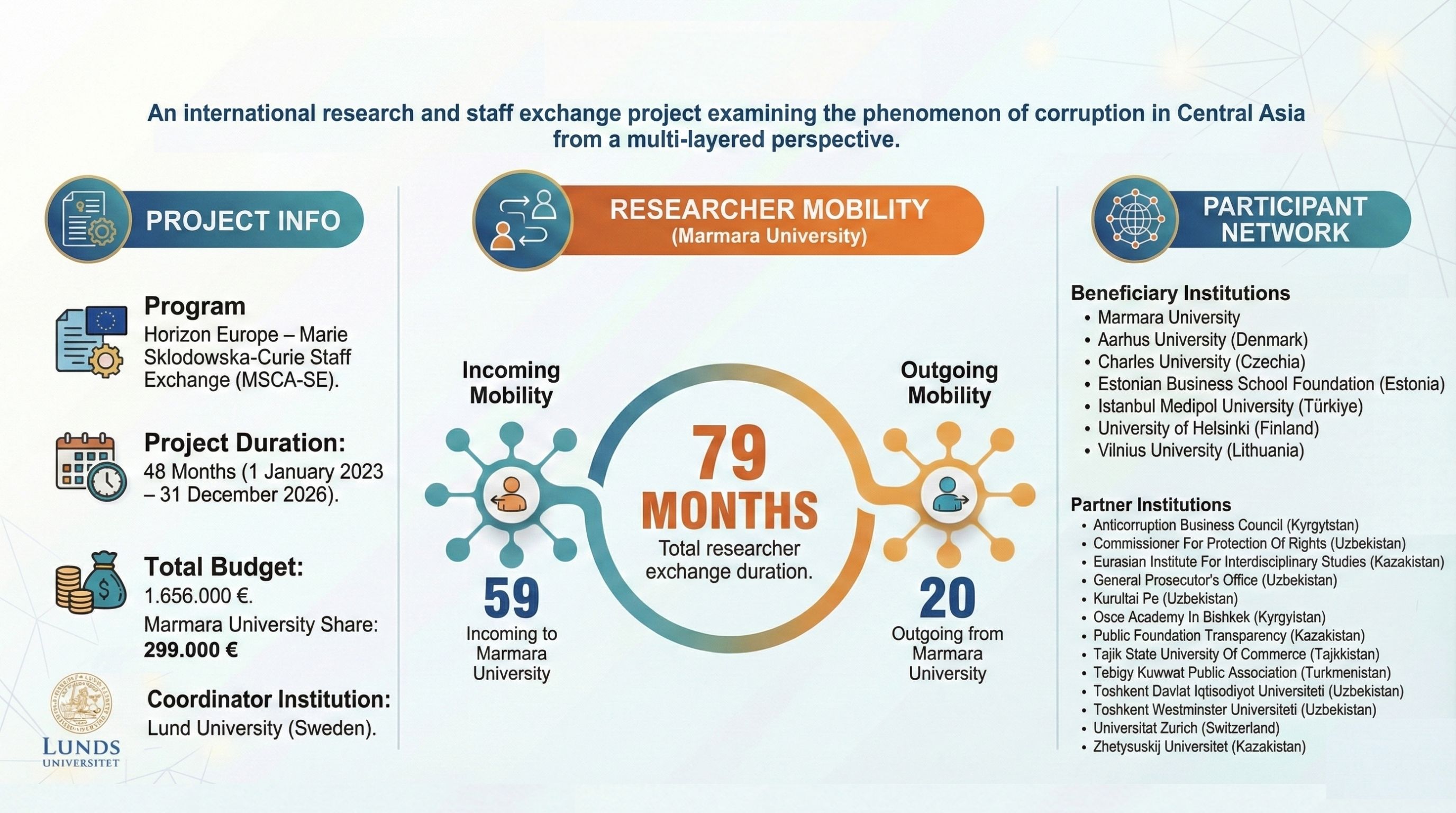
Multilevel Orders of Corruption in Central Asia (MOCCA) is a Horizon Europe project funded under the Marie Skłodowska-Curie Actions – Staff Exchange (MSCA-SE) programme. The project runs from 1 January 2023 to 31 December 2026 with a total budget of €1,656,000.
The project is coordinated by Lund University (Sweden) and brings together an extensive international consortium consisting of 7 beneficiary institutions and 13 partner organizations from Europe and Central Asia.
MOCCA examines corruption in Central Asia through a multilevel perspective, arguing that corruption cannot be understood solely as an individual or institutional failure but rather as a complex social, cultural, legal, and political order. Over the past three decades, the assumption that corruption might accelerate economic growth has largely been replaced by the consensus that corruption undermines sustainable development. Despite numerous global anti-corruption initiatives, durable solutions have remained elusive.
In this context, MOCCA is designed as a research and training initiative that seeks to rethink corruption by analysing the interaction between international legal norms, national legislation, and local cultural practices. Empirical fieldwork is conducted in Kazakhstan, Kyrgyzstan, Tajikistan, Turkmenistan, and Uzbekistan, allowing for a comparative and context-sensitive understanding of corruption and governance practices.
Marmara University participates in MOCCA as a Beneficiary Partner and serves as the National Coordinator for Türkiye, with a total project share of €299,000. Marmara University plays an active role in researcher exchanges, field research, coordination, ethical oversight, and reporting activities.
Within the framework of the project:
- 20 researcher-months are carried out as outgoing secondments from Marmara University.
59 researcher-months are hosted at Marmara University as incoming secondments.
This page updated by MOCCA:Multilevel Orders of Corruption in Central Asia on 24.02.2026 11:06:28


